



Ford Tire Rotation: How Often Should You Rotate Your Tires?
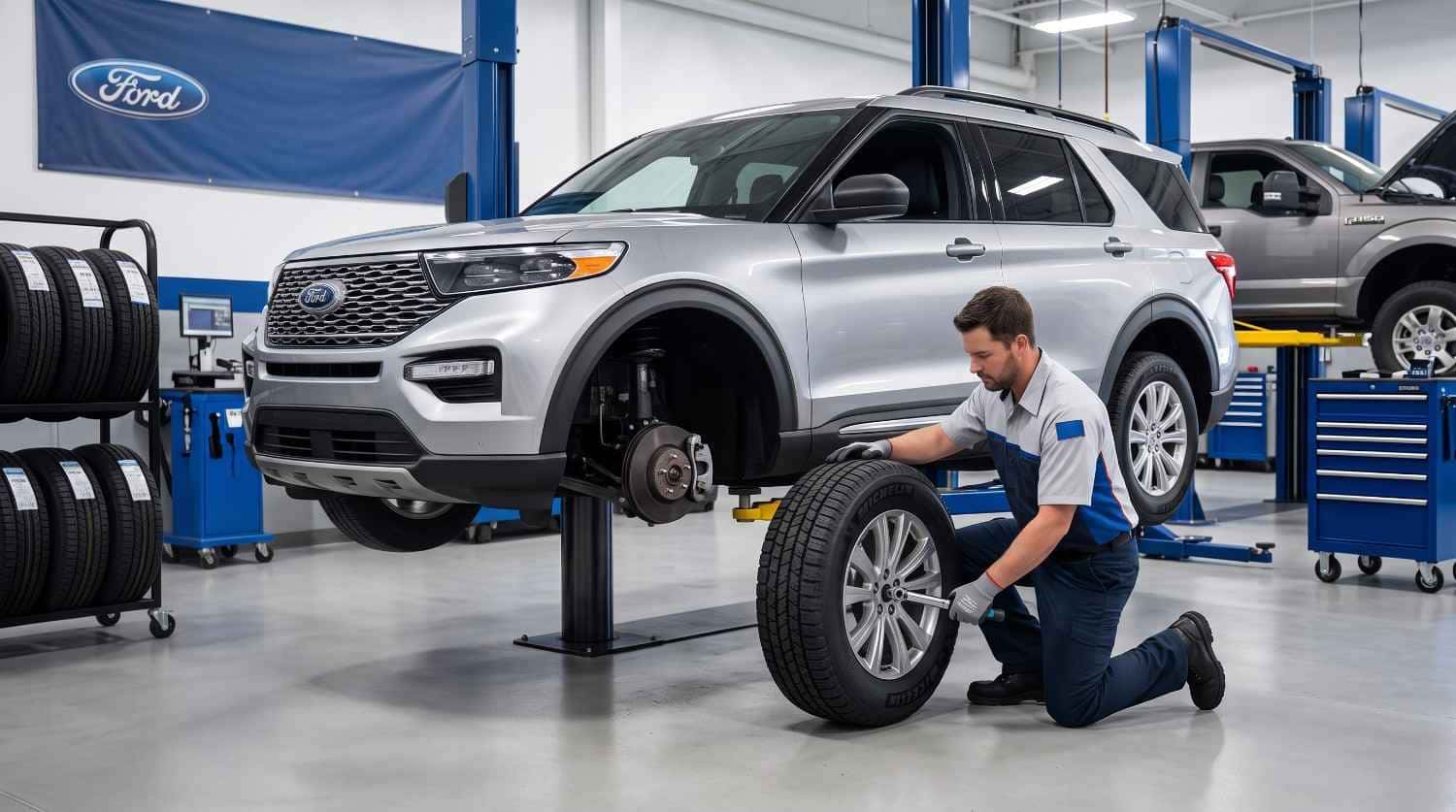
Keeping up with your regular Ford tire rotation is one of the easiest ways to protect your vehicle’s safety, handling, and long-term resale value. Whether you run an F-150 across rural Muskogee County or commute down US-69 in an Escape, your tires take a serious beating every single week. In this comprehensive guide, you’ll learn the exact mileage intervals for your specific model, how rotation patterns work, what happens when you put off maintenance, and how our local certified technicians keep your Ford rolling safely across eastern Oklahoma.
Quick Summary: Most Ford vehicles require a tire rotation every 5,000 to 7,500 miles, or roughly every six months. The simplest way to remember is to rotate your tires at every oil change. Trucks that tow heavy loads or models driven frequently on gravel backroads may need service every 3,000 to 5,000 miles to prevent cupping and premature tread wear.
Key Takeaways
- Standard Interval: Ford recommends a Ford tire rotation every 5,000 to 7,500 miles under normal driving conditions, aligning with your routine synthetic oil change.
- Severe Duty Demands: Driving on rough Oklahoma gravel, hauling livestock trailers, or daily stop-and-go driving reduces that ideal interval down to 3,000 to 5,000 miles.
- Financial Savings: Industry data indicates that routine rotations can extend total tire life by 20% to 30%, potentially saving owners the cost of an entire replacement set over the lifespan of the vehicle.
- Safety & Stopping Distance: National Highway Traffic Safety Administration (NHTSA) testing shows unevenly worn treads can increase wet-braking distances by more than 30 feet at highway speeds.
- Drivetrain Dictates Pattern: Rear-wheel-drive and 4×4 Ford trucks typically use a rearward cross pattern, while front-wheel-drive crossovers rely on a forward cross.
- Warranty Protection: Leading tire manufacturers require verified, documented rotations every 5,000 to 7,500 miles to keep their 50,000-to-80,000-mile treadwear warranties valid.
What Is a Tire Rotation and Why Does It Matter for Ford Vehicles?
Before diving into strict mileage guidelines, let’s break down what is a tire rotation in plain shop terms.
At its core, a rotation involves moving your vehicle’s wheels and tires from one position to another such as swapping the front tires to the rear axle, or moving them diagonally side to side. It sounds straightforward, but it addresses a fundamental law of physics: tires wear out at drastically different rates depending on where they sit on your chassis.
On any vehicle, your front tires shoulder the immense burden of steering, cornering friction, and the majority of your braking force. Every time you negotiate a turn off Shawnee Bypass or brake for a red light on Court Street, your front tires absorb heavy lateral stress.
Add in the weight of your engine block resting squarely over that front axle, and your front rubber inevitably wears down faster on the outside shoulders.
Meanwhile, your rear tires have a completely different job. On an F-150 or Ranger, the rear axle handles the driving torque, pushing thousands of pounds of truck down the pavement while carrying whatever payload you throw in the bed.
If you leave every tire in its original corner for 25,000 miles without touching them, your front tires will chew through their outer tread blocks while your rear tires wear flat down the center.
Routine vehicle tire rotation balances out these uneven physical forces. By cycling each tire through all four wheel positions, you distribute the friction across the entire tread surface of all four tires.
The direct result? Your tires wear down at an even, uniform rate.
That balanced wear preserves your ride quality, keeps road noise down, and ensures your electronic safety systems like Ford Co-Pilot360, AdvanceTrac stability control, and your Anti-Lock Braking System (ABS) can read traction accurately.
Most importantly, proactive Ford tire maintenance ensures you replace all four tires together as a matched set, rather than burning through expensive front pairs every eighteen months.
Ford Tire Rotation Schedule How Often Should You Rotate Your Tires?
A common question our service advisors hear at our Muskogee counter is: how often to rotate Ford tires?
According to Ford’s factory maintenance schedules, the baseline rule of thumb across almost the entire lineup is every 5,000 to 7,500 miles, or at least once every six months whichever milestone arrives first.
If your vehicle comes equipped with the Intelligent Oil-Life Monitor (IOLM), you have an easy built-in reminder. Whenever that dashboard cluster alerts you that it’s time for an oil change, that is your official cue to have your tires rotated and inspected, too.
However, optimal tire rotation mileage is not a one-size-fits-all number. Your drivetrain layout, your daily commute, and how you use your vehicle fundamentally alter how your tires interact with the road.
Front-wheel-drive crossovers like the Escape put driving torque, steering, and braking on the front wheels all at once.
Rear-wheel-drive platforms like the Mustang and Explorer push from the back, with 4WD/AWD variants directing torque to all four wheels as needed.
Here is how the Ford tire rotation schedule breaks down across different drivetrains and operating conditions:
| Ford Vehicle Category | Drivetrain Configuration | Example Ford Models | Standard Rotation Interval | Severe Duty Interval (Towing / Rough Roads) |
| Compact & Midsize SUVs | Front-Wheel Drive (FWD) | Escape, Maverick FWD | 5,000 – 7,500 miles | 3,000 – 5,000 miles |
| All-Wheel Drive SUVs | Intelligent AWD | Explorer, Edge, Escape AWD, Bronco Sport | 5,000 – 7,500 miles | 4,000 – 5,000 miles |
| Off-Road SUVs | Advanced 4×4 / AWD | Bronco, Bronco Sport | 5,000 – 6,000 miles | 3,000 – 4,000 miles (Aggressive A/T Treads) |
| Light & Midsize Trucks | RWD / Part-Time 4×4 | Ranger, F-150 | 5,000 – 7,500 miles | 3,000 – 5,000 miles (Frequent Towing) |
| Heavy-Duty Trucks | Heavy 4×4 / SRW | F-250, F-350 Super Duty | 5,000 – 7,500 miles | 3,000 – 4,000 miles (Commercial / Ag Use) |
| Dual Rear Wheel Trucks | Dually (DRW) 4×4 | F-350 DRW, F-450 | 5,000 – 7,500 miles | 4,000 – 5,000 miles (Special Dually Pattern) |
| Electric Vehicles (EV) | Dual Motor e-AWD | F-150 Lightning, Mustang Mach-E | 5,000 – 7,500 miles | 4,000 – 5,000 miles (Instant Torque Wear |
If your daily drive includes unpaved country lanes around Fort Gibson Lake, washboard farm tracks, or stop-and-go hauling down Muskogee’s industrial corridors, lean closer to that 3,000-to-5,000-mile mark.
Our Oklahoma summer heat pushes pavement temperatures well past 120 degrees Fahrenheit. Hot asphalt softens tire rubber compounds, speeding up tread erosion and making strict adherence to your rotation schedule vital.
Signs Your Ford Needs a Tire Rotation Sooner
You do not always have to wait until your odometer rolls over another 5,000 miles to service your tires. Real-world driving brings unexpected hazards: potholes, sudden curb bumps, and uneven road crowns that can trigger irregular wear patterns long before your next scheduled oil change.
Learning to spot early warning signs can save you hundreds of dollars in premature tire replacements.
Uneven Tread Depth Across the Same Axle
Grab a tread depth gauge or a standard penny. Insert Abraham Lincoln’s head upside down into the tread grooves across the inner shoulder, the center ribs, and the outer shoulder.
If the outer edge shows significantly less tread than the center, or if your front tires show 2/32-inch less depth than your rear tires, they need an immediate rotation.
Steering Wheel Vibration at Highway Speeds
When you merge onto the Muskogee Turnpike and feel a distinct, rhythmic shimmy in your steering wheel around 55 to 70 mph, your front tires are crying for help.
While vibrations can point to an out-of-balance wheel or an alignment issue, they frequently stem from cupped tires. Cupping happens when an unrotated tire bounces subtly down the highway, carving small scoops out of the rubber.
“Heel-Toe” or Sawtooth Wear
Run your open palm gently along the circumference of your tire tread blocks. Does the rubber feel smooth in one direction but sharp, jagged, or stepped when you pull your hand the other way?
That is known as heel-toe wear. It creates a loud, droning road noise that many drivers mistake for a failing wheel bearing. A timely rotation flips the direction of friction and smooths out those high spots before the tire is ruined.
Persistent Air Pressure Loss in One Corner
If one tire constantly drops 3 to 4 PSI every couple of weeks while the others hold steady, do not simply pump it back up and ignore it.
Irregular stress distribution, subtle bead seating gaps, or an overlooked puncture on an overworked corner can lead to slow pressure loss. Rotating the tires gives a technician the perfect opportunity to inspect the entire casing on a lift.
Tire Rotation on Ford Pickup Trucks (F-150, Ranger, Super Duty)
Performing a tire rotation on pickup truck models involves unique mechanical factors that passenger cars simply do not encounter.
Ford trucks are engineered to carry serious payloads in the bed and pull heavy equipment trailers across highway miles. These demanding conditions create specialized wear patterns on truck tires.
When you haul a loaded horse trailer, boat, or work trailer, thousands of pounds of tongue weight press down directly onto your rear axle.
This extreme downward force creates intense friction and heat on the center tread blocks of your rear tires.
Conversely, when the truck bed is completely empty, the rear of an F-150 or Super Duty is comparatively light. An unloaded truck bed allows the rear tires to bounce subtly over rough pavement, causing light scuffing or cupping if left unrotated.
Up front, heavy-duty steering linkages and the weight of a 3.5L EcoBoost, 5.0L Coyote V8, or 6.7L Power Stroke Turbo Diesel push down hard on the front suspension.
Every tight turn into a job site or farm gate forces the outer tread shoulders of those front tires to scrub against abrasive asphalt.
If you skip your tire rotation on pickup truck platforms, you will see a severe disparity between your front and rear treads in fewer than 10,000 miles.
Furthermore, Ford Super Duty dually trucks (F-350 and F-450 DRW) require an entirely distinct rotation approach. With six tires across two axles, rotating requires dismounting and remounting tires on different rims, or following an intricate six-tire rotation sequence.
This ensures inner and outer dual wheels share highway friction evenly, preventing premature inner-tire blowouts under heavy payloads.
What Happens If You Skip Tire Rotations?
It is easy to look at your service reminder, think “the truck drives fine,” and push off your tire rotation for another few months.
However, ignoring this basic maintenance step triggers an expensive chain reaction that affects much more than just tire life:
- Severely Shortened Tire Lifespan: Skipping rotations causes rapid, isolated wear on specific tire edges. Instead of getting 60,000 miles out of a premium set of Michelin or Goodyear tires, you may be forced to scrap them at 30,000 miles because the front shoulders have worn down to the steel safety cords.
- Reduced Wet-Weather Safety and Longer Braking Distances: Tires with uneven tread depths cannot channel away standing water efficiently. When sudden Oklahoma thunderstorms soak the pavement, unevenly worn tires make your vehicle prone to dangerous hydroplaning and noticeably increase emergency stopping distances.
- Compromised Fuel Efficiency: When tires wear unevenly, their rolling resistance increases significantly. Your Ford’s engine has to burn extra fuel simply to overcome that dragging, ragged tread contact patch, noticeably pulling down your miles-per-gallon (MPG).
- Strain on Drivetrain and All-Wheel-Drive Systems: Ford’s Intelligent AWD and 4×4 systems rely on wheel-speed sensors to detect traction loss. If unrotated front tires wear down to a smaller overall rolling circumference than the rears, those sensors detect false wheel-slip. This causes unnecessary heat and mechanical strain on your center transfer case and differential clutches.
- Voided Treadwear Warranties: Most major tire manufacturers require documented maintenance records showing regular rotations every 5,000 to 7,500 miles; lacking these records often leaves mileage warranty claims open to denial.
- Suspension and Wheel Bearing Wear: Severe tire cupping or flat spots create high-frequency vibrations that travel directly into your wheel bearings, tie rods, ball joints, and struts, leading to premature suspension repairs down the road.
Ford Tire Rotation Cost What to Expect
The good news is that tire rotations are one of the most affordable maintenance services in the entire automotive world.
On a standalone basis, a standard four-wheel Ford tire rotation typically ranges between $25 and $55 for most passenger cars and light trucks, though heavy-duty dual-rear-wheel (DRW) setups may cost more due to the labor involved.
However, experienced Ford owners rarely pay for tire rotations as an isolated service. Dealerships routinely bundle tire rotations into comprehensive preventive maintenance packages.
For instance, when you bring your vehicle in for Ford’s signature “The Works” service package, your tire rotation is packaged alongside a synthetic blend or full synthetic oil change, oil filter replacement, complete brake inspection, battery test, fluid top-offs, and a multi-point safety inspection.
Taking advantage of published service specials and maintenance coupons makes the per-service cost remarkably budget-friendly.
Spending $30 to $40 twice a year to rotate your tires protects an $800 to $1,500 investment in rubber. In terms of pure return on investment, regular tire rotation is the single most cost-effective maintenance task you can perform.
Why Trust This Guide: Our Ford Service Expertise
When you are deciding how to maintain your vehicle, where your information comes from matters just as much as the numbers on the page.
This guide is built on official Ford factory workshop manuals, engineering service bulletins, and the real-world wrench time of our factory-certified technicians at James Hodge Ford in Muskogee, OK.
Every week, our service bays handle dozens of Ford platforms from family-driven Escapes and Explorers to heavy commercial F-250 and F-350 Super Duty haulers.
We know firsthand how our local roads, seasonal weather swings, and heavy hauling demands affect tire rubber over time.
Our technicians undergo rigorous factory training directly through Ford Motor Company. They understand the exact torque specifications for your lug nuts, how to properly reset Ford Tire Pressure Monitoring System (TPMS) sensors after wheel positions change, and how to spot subtle suspension misalignments before they ruin an expensive set of all-terrain tires.
When you bring your vehicle to our team, you receive guidance backed by genuine Ford engineering standards, cutting-edge diagnostic equipment, and certified technical knowledge.
Federal safety research and tire industry testing demonstrate that depleted or severely uneven tread blocks can significantly degrade wet traction, adding multiple car lengths to emergency braking distances at highway speeds.
Everything we recommend is focused on keeping your Ford operating safely, dependably, and efficiently for years to come.
DIY vs Professional Ford Tire Rotation
Some handy vehicle owners prefer to tackle basic maintenance in their own driveway on Saturday mornings.
While rotating your own tires is certainly possible, it helps to weigh what is involved before deciding between the DIY route and professional shop service:
DIY Tire Rotations
Pros
- Zero labor cost; requires only your personal time.
- You can inspect your brake pads and clean your wheel barrels at your own pace.
- Complete personal control over your vehicle’s maintenance.
Cons
- Requires heavy-duty equipment: a reliable hydraulic floor jack, at least two (preferably four) heavy-duty jack stands, wheel chocks, and a calibrated torque wrench.
- Lifting a 6,000-pound truck on home jack stands carries inherent safety risks if not done on level, solid concrete.
- You must manually relearn or retrain your vehicle’s TPMS sensors so your dashboard displays tire pressures at the correct corners.
- It takes significant physical labor, especially when handling heavy, mounted 10-ply Super Duty wheels that weigh 75 to 90 pounds each.
Professional Dealership Tire Rotations
Pros
- Fast and effortless: commercial hydraulic vehicle lifts allow technicians to rotate all four wheels in under 15 minutes.
- Includes a factory-spec multi-point inspection of your brake pads, rotors, shocks, tie rods, and steering knuckles while the wheels are off.
- Wheels are torqued precisely to Ford factory specifications using calibrated tools, preventing warped brake rotors and stripped wheel studs.
- Technicians use digital Ford scan tools to instantly recalibrate your TPMS sensors to their new axle positions.
- Every rotation is entered directly into your vehicle’s official Ford digital service history, preserving your factory and tire warranties.
Cons
- Requires a short scheduled appointment at the dealership service center.
- Incurs a modest service charge if not bundled with an oil change or maintenance package.
Keep Your Ford Rolling Smoothly in Muskogee
Staying on top of your routine Ford tire rotation is the simplest, most effective way to maximize your tire investment, protect your fuel economy, and keep your family safe on Oklahoma highways.
Whether you need a quick 5,000-mile rotation, an electronic wheel balance, or a brand-new set of factory-approved tires, the factory-trained technicians at James Hodge Ford Muskogee are here to help.
Our team knows your truck or SUV inside and out, and we are committed to delivering honest, expert service every time you pull into our service drive.
Ready to give your tires the care they deserve? Schedule your next service appointment online with our service team, or visit our dealership tire center to find the ideal replacement tires for your vehicle today.
Frequently Asked Questions
How often should I rotate my Ford’s tires?
Rotate your tires every 5,000 to 7,500 miles, or whenever you get an oil change. If you tow frequently or drive on rough roads, rotate them sooner every 3,000 to 5,000 miles.
What is the recommended tire rotation pattern for a Ford F-150?
The rearward cross pattern is recommended. Move the rear tires straight to the front axle, and cross the front tires diagonally to the opposite sides of the rear axle.
Can I rotate my own tires, or should I go to a Ford dealer?
You can do it yourself if you have a floor jack, jack stands, and a torque wrench. However, a dealership ensures precise factory torque, TPMS recalibration, and a multi-point inspection.
Does skipping tire rotations void my Ford warranty?
It won’t void your overall Ford warranty, but it will void your tire manufacturer’s treadwear warranty. Any mechanical damage caused directly by uneven tires may also not be covered.
How much does a Ford tire rotation cost at a dealership?
A standalone rotation typically costs between $25 and $55. Most drivers bundle it with routine oil changes or maintenance packages to save money.
Should I rotate all four tires or just two?
Always rotate all four tires to ensure even tread wear across every wheel position. Only dual-rear-wheel (DRW) Super Duty trucks require a special six-tire rotation.

0 comment(s) so far on Ford Tire Rotation: How Often Should You Rotate Your Tires?