



Ford Bronco vs Jeep Wrangler: Which Off-Road SUV Is Better?
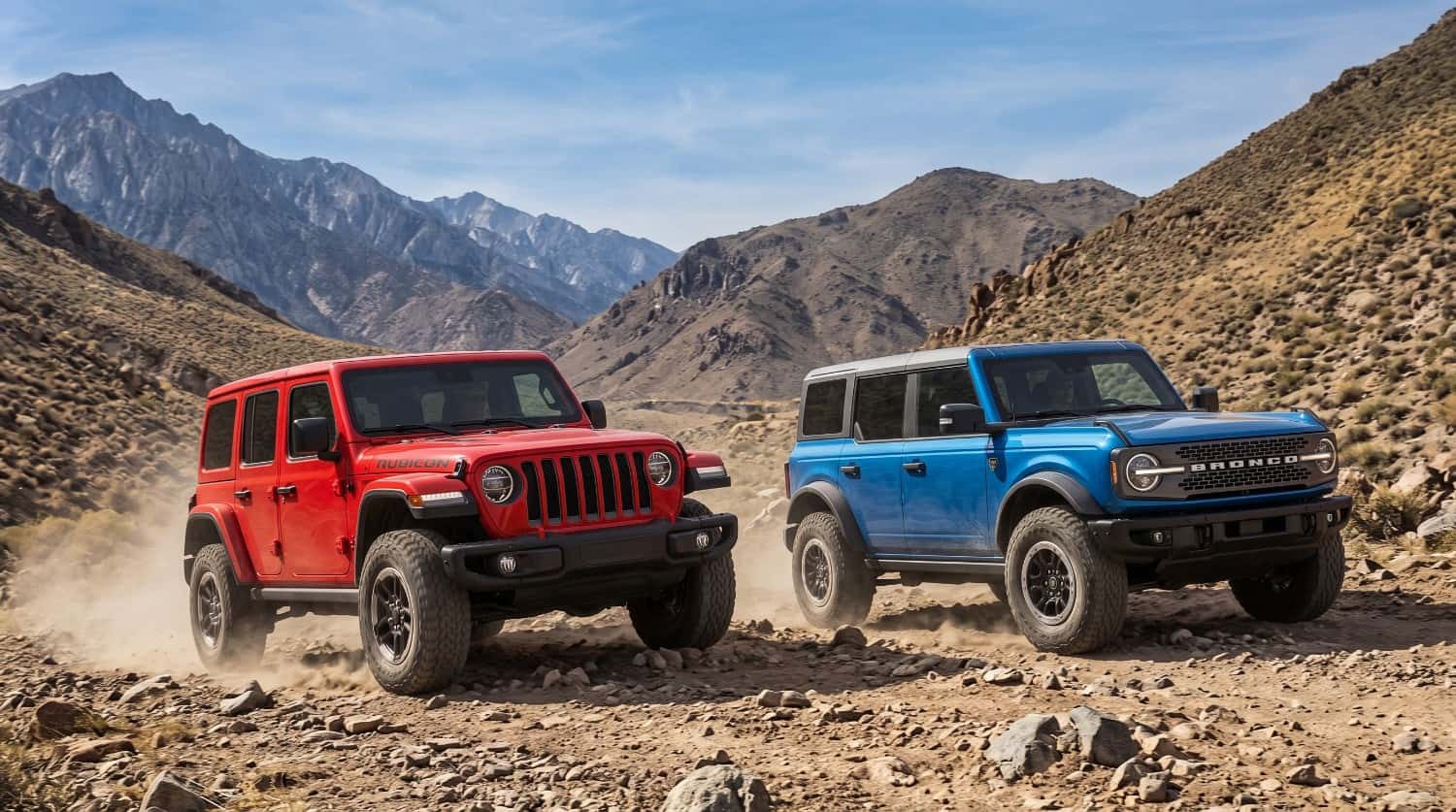
Walk into our showroom at Hodge Ford on any given Saturday, and you will hear the exact same debate. A customer points out the window at a two-door on 35s, arms crossed, weighing the Jeep Wrangler vs Ford Bronco. They love open-air freedom, trail adventures, and that classic utilitarian look.
Both rigs deliver the open-air dream. You can strip the roof off, pull the doors off, and crawl up a rocky wash on a Sunday afternoon. Each carries decades of heritage and loyal followings that wave at their own kind on every backroad in America.
Yet despite their shared DNA, they drive like night and day. One stays stubbornly loyal to classic solid-axle trail roots, while the other redesigns the modern adventure vehicle around civilized highway manners.
If you’re stuck trying to choose which keys to take home, it comes down to how you actually plan to spend your week.
Quick Summary: In the Jeep Wrangler vs Ford Bronco showdown, the right choice hinges on how you balance extreme rock crawling with everyday driving. The Jeep Wrangler edges out dedicated low-speed rock crawling thanks to its live front axle, while the Ford Bronco wins on highway manners, cabin tech, and high-speed trail stability due to its independent front suspension. For buyers using their off-roader as a true daily driver, the Bronco offers a far more composed, fatigue-free ride without giving up genuine trail capability.
Key Takeaways
- Off-road tech: The Wrangler relies on classic solid front and rear axles for maximum articulation, whereas the Bronco pairs an independent front suspension (IFS) with advanced G.O.A.T. Modes for better high-speed desert running and trail versatility.
- Price gap: Base two-door Wranglers often start slightly lower on entry trims, but standard equipment levels out fast once you step up to off-road packages like Rubicon or Badlands.
- Reliability records: Both bring bulletproof, time-tested powertrains to the table, though the Bronco’s steering setup and electrical architecture show far less wandering and wear over long highway stretches.
- Towing ratings: Most configurations land in the 3,500-lb range, though select four-door Wrangler builds reach up to 5,000 lbs, while the heavy-hitting Bronco Raptor pulls 4,500 lbs.
- Daily comfort: The Bronco runs away with daily livability thanks to precise rack-and-pinion steering, a wider track, and a noticeably quieter cabin at 70 mph.
Ford Bronco vs Jeep Wrangler at a Glance
| Feature | Ford Bronco | Jeep Wrangler |
| Engine Options | 2.3L EcoBoost I-4, 2.7L EcoBoost V6, 3.0L EcoBoost V6 (Raptor) | 3.6L Pentastar V6, 2.0L Turbo I-4, 2.0L PHEV (4xe), 6.4L V8 (392) |
| Horsepower | 300 hp to 418 hp | 270 hp to 470 hp |
| Max Towing Capacity | 3,500 lbs (Standard) / 4,500 lbs (Raptor) | 2,000 lbs (2-Door) / 3,500–5,000 lbs (4-Door) |
| Starting MSRP | ~$39,995 (Base) | ~$32,000 (Sport 2-Door) |
| Door & Roof Design | Frameless doors (stow onboard in 4-door), modular hardtop/soft top | Framed doors (garage storage needed), Sunrider/hardtop/Sky One-Touch |
| Ideal Buyer | Daily commuters who want trail-ready capability without highway wander | Die-hard rock crawlers wanting maximum articulation and hybrid/V8 choices |
What’s the Real Difference Between the Bronco and the Wrangler?
The fundamental split between these two rigs boils down to where their engineering priorities start. The Jeep Wrangler treats the street as a mere transit stage between trails. It stays devoted to a design template forged during World War II: solid live axles front and rear, boxy upright proportions, and a purely mechanical feel. When you take the roof and doors off a Wrangler, you feel like you are operating a purpose-built piece of open-air trail equipment that happens to be street-legal.
Ford engineered the Bronco to solve every gripe people have had about driving an off-roader Monday through Friday. Built on a modified Ranger chassis, it brings an independent front suspension, frameless glass doors you can stow inside the cargo area, and cowl-mounted mirrors that stay on the vehicle when the doors come off. It delivers that same wind-in-your-hair freedom, but without making you fight the steering wheel all the way to the trail.
Bronco vs Jeep Wrangler Size and Dimensions
| Specification (4-Door Trim Comparison) | Ford Bronco (Badlands / Sasquatch) | Jeep Wrangler (Rubicon) |
| Overall Length | 189.4 inches | 188.4 inches |
| Overall Width (without mirrors) | 75.9 to 79.3 inches | 73.8 inches |
| Overall Height | 73.0 to 75.2 inches | 73.6 inches |
| Wheelbase | 116.1 inches | 118.4 inches |
| Max Ground Clearance | 11.6 inches (Sasquatch) | 10.8 to 11.1 inches (Xtreme 35) |
| Approach Angle | 43.2° (Sasquatch) | 44.0° to 47.4° (Xtreme 35) |
| Departure Angle | 37.2° (Sasquatch) | 37.0° to 40.4° (Xtreme 35) |
| Breakover Angle | 26.3° (Sasquatch) | 22.6° to 27.8° (Xtreme 35) |
Those numbers show up the minute you pull out of a tight parking spot or squeeze between boulders. The Wrangler’s narrower body gives it an edge when threading through dense hardwood timber, where every inch between oak trees counts. However, the Bronco’s wider stance and track pay massive dividends in everyday stability, giving you planted lane-keeping on the interstate and rock-solid lateral balance on steep, off-camber hillside washouts.
Bronco vs Wrangler Off-Road Capability
When you take both rigs past the trailhead, their mechanical differences immediately show up in how they tackle dirt, mud, and rock. The Wrangler Rubicon relies on its legendary Rock-Trac system, delivering an ultra-low 4:1 transfer case gear ratio that crawls down steep descents with pure mechanical control. Ford counters with an advanced two-speed electromechanical transfercase, available 4.7:1 axle gearing via the Sasquatch package, and Terrain Management with selectable G.O.A.T. Modes that calibrate throttle, traction control, and shift logic on the fly.
Where the Bronco truly pulls ahead in usable technology is the sway bar disconnect and tight-trail maneuvering. Jeep requires the front axle to be on relatively level, unloaded ground to disconnect its sway bar. Ford’s semi-active hydraulic system can disconnect under full suspension load in the middle of an obstacle, instantly restoring front wheel droop and traction. Pair that with Trail Turn Assist which brakes the inside rear wheel to pivot the vehicle around tight switchbacks and the Bronco makes navigating tricky trails remarkably effortless.
| Off-Road Feature | Ford Bronco (Sasquatch / Badlands) | Jeep Wrangler (Rubicon) |
| 4×4 System | Advanced 4×4 with Auto On-Demand & G.O.A.T. Modes | Rock-Trac Heavy-Duty Part-Time or Full-Time 4WD |
| Crawl Ratio | Up to 67.8:1 (Automatic) / 94.75:1 (Manual) | Up to 77.2:1 (Automatic) / 100:1 (Manual) |
| Sway Bar Disconnect | Semi-active hydraulic (disconnects under load) | Electronic disconnect (requires level, unloaded axle) |
| Differentials | Electronic locking front and rear (Dana AdvanTEK) | Tru-Lok electronic locking front and rear (Dana 44) |
| Trail Assists | Trail Turn Assist, Trail 1-Pedal Drive, Trail Control | Off-Road+ mode, Selec-Speed Control |
| Max Factory Tire Size | 35-inch (Sasquatch) / 37-inch (Raptor) | 33-inch standard / 35-inch (Xtreme 35 Package) |
Straight out of the box, the Wrangler remains the purest machine for dedicated, boulder-crawling articulation where its solid front axle keeps both front tires planted on uneven surfaces. But for almost every other off-road scenario muddy ruts, washboard fire roads, high-speed sand running, and winding forest trails the Bronco delivers a more confident, accessible experience that does not punish your body along the way.
Bronco vs Wrangler Towing Capacity and Performance
If you plan to drag weekend toys to the lake or pull a camper down a logging road, powertrain muscle and chassis ratings matter. Ford builds the Bronco exclusively with turbocharged EcoBoost engines, giving you heavy low-end torque right off idle. Jeep counters with naturally aspirated displacement, a punchy turbo four-cylinder, a torquey plug-in hybrid (4xe), and the raw rumble of a 392 V8.
| Powertrain / Model | Horsepower | Torque | Max Towing Capacity |
| Bronco 2.3L EcoBoost I-4 | 300 hp | 325 lb-ft | 3,500 lbs (2-Door & 4-Door) |
| Bronco 2.7L EcoBoost V6 | 330 hp | 415 lb-ft | 3,500 lbs (2-Door & 4-Door) |
| Bronco 3.0L EcoBoost V6 (Raptor) | 418 hp | 440 lb-ft | 4,500 lbs |
| Wrangler 3.6L Pentastar V6 | 285 hp | 260 lb-ft | 2,000 lbs (2-Door) / Up to 5,000 lbs (4-Door) |
| Wrangler 2.0L Turbo I-4 | 270 hp | 295 lb-ft | 2,000 lbs (2-Door) / Up to 5,000 lbs (4-Door) |
| Wrangler 2.0L PHEV (4xe) | 375 hp | 470 lb-ft | 3,500 lbs (4-Door Only) |
| Wrangler 6.4L HEMI V8 (392) | 470 hp | 470 lb-ft | 3,500 lbs (4-Door Only) |
5,000-lb capacity requires specific 4-door Wrangler trims (like Rubicon) equipped with the full-float Dana 44 rear axle and automatic transmission. Most standard 4-door trims top out at 3,500 lbs.
When towing teardrop campers, personal watercraft, or a pair of ATVs on an aluminum trailer, both rigs handle typical 2,500- to 3,500-lb setups with ease. The two-door Bronco holds a major edge over the two-door Wrangler, keeping its full 3,500-lb rating while the stubby two-door Jeep caps out at 2,000 lbs.
However, if you’re pulling a heavier 20-foot tandem-axle travel trailer or loaded dual-axle utility hauler, a properly optioned four-door Wrangler Rubicon with the 5,000-lb rating gives you breathing room that standard Broncos cannot match. Just keep in mind that neither SUV replaces a full-size truck for long-haul cross-country towing; these short-wheelbase chassis are tuned first and foremost for trail suspension travel.
Ford Bronco vs Jeep Wrangler Price
Look at the window stickers across both lineups, and you will see how differently these two brands price their hardware. Jeep casts a wider net with ultra-stripped budget models at the bottom and a collector-grade V8 at the top. Ford bunches its core trims closer together, giving you more modern tech out of the gate.
| Trim Category / Style | Ford Bronco Trim & Starting MSRP | Jeep Wrangler Trim & Starting MSRP |
| Entry Level | Base (~$39,890) / Big Bend (~$42,265) | Sport ($32,690) / Sport S ($35,695) |
| Mid-Tier Trail | Black Diamond / Heritage (~$51,370) | Willys ($40,190) |
| Comfort & Tech | Outer Banks (~$49,835) | Sahara (~$49,370, 4-Door only) |
| Hardcore Off-Road | Badlands (~$51,990) | Rubicon ($47,550) / Rubicon X ($57,500) |
| High-Performance Flagship | Raptor (~$90,035) | Rubicon 392 Final Edition (~$100,590) |
Base pricing reflects typical 2-door or entry 4-door starting MSRPs before destination, dealer add-ons, or custom option packages.
The initial price gap at the low end looks wide, but it shrinks the second you look at standard equipment. A base Wrangler Sport keeps costs down with crank windows and manual locks, whereas even an entry Bronco comes loaded with standard 4×4, the 12-inch SYNC 4 touchscreen, and driver-assist safety gear.
If you are hunting for pure dollar-for-dollar value on the trail, the Wrangler Willys is tough to beat for a sub-$45k crawler with a locking rear diff and 33s. But once you step into the $50k range, the Ford Bronco vs Jeep Wrangler price calculation flips. A Bronco Badlands or a Big Bend equipped with the Sasquatch Package gives you front and rear lockers, 35-inch tires, and Bilstein position-sensitive dampers delivering unbeatable value without requiring aftermarket upgrades.4
Jeep Wrangler vs Ford Bronco Reliability
Our service team fields questions about this constantly, and here’s what we tell customers: neither of these rigs behave like an ordinary, low-maintenance commuter crossover. Both are purpose-built 4x4s with heavy-duty drivelines, removable body panels, and hardware meant to take genuine punishment.
On the Jeep side, the naturally aspirated 3.6L Pentastar V6 and ZF-sourced 8-speed automatic have logged millions of miles over more than a decade. That drivetrain is thoroughly debugged and predictable. However, our technicians frequently talk to Jeep trade-ins dealing with steering gear play, ball joint wear, and the dreaded steering shimmy common to aging solid front axles. The 4xe hybrid models have also prompted their share of customer headaches around electrical bugs and software updates.
Ford’s 2.3L and 2.7L EcoBoost powertrains are well-proven workhorses straight from the Ranger and F-150. Because the Bronco uses an independent front suspension with rack-and-pinion steering, it doesn’t develop the wandering front-end slop that solid-axle rigs suffer from as bushings take a beating. Most early Bronco complaints centered around soft-top weather seals and first-year roof latches, cosmetic fit-and-finish items that Ford addressed in subsequent model years rather than mechanical breakdowns.
| Warranty & Coverage Item | Ford Bronco | Jeep Wrangler |
| Bumper-to-Bumper Warranty | 3 years / 36,000 miles | 3 years / 36,000 miles |
| Powertrain Warranty | 5 years / 60,000 miles | 5 years / 60,000 miles |
| Roadside Assistance | 5 years / 60,000 miles | 5 years / 60,000 miles |
| Complimentary Maintenance | None standard (earn FordPass points) | 24 months / 2 oil changes & rotations (Jeep Wave) |
| Corrosion / Perforation | 5 years / Unlimited miles | 5 years / 100,000 miles |
Factory coverage is virtually neck-and-neck, with Jeep offering a minor perk upfront via its two-year Jeep Wave maintenance program. If you keep up with standard fluid changes and check your suspension after heavy trail outings, both platforms will easily cross the 150,000-mile mark without drama. But day in and day out, the Bronco’s modern chassis geometry means significantly fewer steering adjustments and alignment visits over your ownership life.
Bronco vs Wrangler Interior and Daily Comfort
Spending 45 minutes stuck in weekday traffic will tell you more about these SUVs than any dirt trail ever could. When the doors and roof are buttoned up, the Bronco feels noticeably more like a civilized daily commuter, while the Wrangler constantly reminds you of its pure utilitarian roots.
The Bronco’s wider cabin gives your shoulders breathing room and makes the cockpit feel airy rather than pinched. While neither vehicle is whisper-quiet compared to a crossover, the Bronco’s independent front suspension absorbs bridge expansion joints and potholed city streets without jarring your spine or sending vibrations up through the steering column.
- Infotainment & Controls: Every Bronco now sports a standard 12-inch SYNC 4 touchscreen with snappy wireless Apple CarPlay and Android Auto. Jeep answered with its own sleek 12.3-inch Uconnect 5 display across all trims, making screen real estate essentially a dead heat.
- Materials & Washability: Both cockpits are designed to get dirty. Ford offers marine-grade vinyl seats with rubberized flooring and passive drain plugs that rinse out easily. Jeep delivers comparable water-resistant cloth or leather, but Ford’s silicone-sealed dash switches hold a slight edge in grime protection.
- Highway Noise Levels: Wind noise is a reality in any square-jawed 4×4, but the Bronco’s raked windshield glass cuts the air with less turbulence. In our test drives at 70 mph, the Bronco hardtop delivers a measurably calmer cabin than the Wrangler’s upright windshield, which catches head drafts like a sail.
- Ergonomics & Storage: Bronco features clever touches like dash-top mounting tracks for GoPros or GPS devices and 12V power points right where you need them. Plus, because its mirrors are cowl-mounted, you still have rear visibility when the doors are off unlike the door-mounted mirrors on a naked Wrangler.
Bronco vs Wrangler Safety Features and Crash Protection
Stripping the doors off an open-air SUV naturally raises safety questions, especially if you carry family. Ford designed the Bronco with this in mind from day one, mounting side curtain airbags directly into the upper roll cage sports bar. That means full head protection stays active even with all four doors removed a crucial feature Jeep only recently addressed.
In testing by the Insurance Institute for Highway Safety (IIHS), that dedicated structural focus shows up in real numbers:
- Crash Test Performance: The Bronco earned an overall “Good” rating in the front small-overlap crash test. In the same barrier evaluations, the Wrangler was downgraded to “Marginal” after tipping onto its side.
- Standard Driver Assists: Ford packs available Co-Pilot360 tech like Pre-Collision Assist and Automatic Emergency Braking across most trims, whereas Jeep frequently gates key active safety features behind optional add-on packages.
- Trail Awareness: Bronco’s optional 360-degree camera with split-view overlays acts as a digital spotter, helping you steer clear of steep drop-offs and blind rocks.
Both vehicles are built tough, but the Bronco’s wider footprint and cage-integrated airbags give you noticeably better peace of mind on the highway.
Which One Should You Buy
Choose the Jeep Wrangler If:
- Pure rock crawling is your absolute priority: You want maximum suspension articulation right out of the box. A live front axle remains the undisputed king when slow-crawling over massive boulder fields where keeping all four tires firmly pinned to uneven rock shelves is what matters most.
- You want a bare-bones, low-entry trail rig: You prefer simpler mechanical setups and want to build your own custom trail beast from the ground up without paying for tech packages or digital driver aids you simply will not use.
- You prefer naturally aspirated displacement or plug-in power: You want the classic feel of the bulletproof 3.6L Pentastar V6, the short-range electric commuting capability of the 4xe plug-in hybrid, or the earth-shaking rumble of a factory V8.
- You bleed Jeep heritage: You love the deep aftermarket support, the universal Jeep wave culture, and driving an uninterrupted direct descendant of the original World War II open-air silhouette.
Choose the Ford Bronco If:
- Your trail rig doubles as your daily commuter: You want planted highway tracking, effortless rack-and-pinion steering, and an independent front suspension that absorbs ragged city asphalt and bridge joints without demanding two-handed corrections at 70 mph.
- You want the legendary Sasquatch Package: You want aggressive 35-inch factory tires, Bilstein position-sensitive dampers, and front and rear electronic lockers available across the entire lineup without being forced into one ultra-expensive top trim.
- You demand smarter open-air utility: You value cowl-mounted mirrors that stay put when the doors come off, frameless doors that stow neatly inside the back of the 4-door, and modern silicone-sealed switches that laugh off rain and dirt.
- You want long-term chassis durability: You want a modern steering geometry that doesn’t develop front-end wandering slop over time, paired with an unlimited-mileage corrosion warranty that protects your investment through seasons of road salt and muddy trail runs.
Test Drive the Bronco at Hodge Ford
Reading specs online only gets you so far. Our team at Hodge Ford spends every day walking drivers through this exact matchup. In fact, many of our happiest Bronco owners originally pulled onto our lot driving a Wrangler.
We invite you to take the Bronco out on local blacktop, merge onto the highway at 70 mph, and test the steering yourself. There’s never any high-pressure sales pitch, just honest advice from folks who know these 4x4s inside and out.
Conclusion
The Jeep Wrangler vs Ford Bronco debate isn’t about crowning a single universal winner; it’s about matching the vehicle to your actual weekly routine. The Wrangler remains an undisputed icon of mechanical boulder crawling with unmatched solid-axle articulation.
Yet for real-world drivers, the Bronco wins the complete package. It delivers serious trail capability while giving you a dramatically quieter, fatigue-free Monday-through-Friday commute. Visit Hodge Ford today, grab the keys, and feel the difference on the open road.
Frequently Asked Questions
Is the Ford Bronco better off-road than the Jeep Wrangler?
It depends on the terrain. The Wrangler edges out extreme boulder crawling thanks to its solid front axle articulation. The Bronco dominates high-speed dirt trails, washboard gravel, and sand due to its independent front suspension and intelligent G.O.A.T. Modes.
Which is more reliable, the Ford Bronco or Jeep Wrangler?
Both use proven engines that easily reach high mileage with regular fluid changes. However, the Bronco’s modern rack-and-pinion steering avoids the front-end wobble, steering box play, and suspension slope common to aging solid-axle Wranglers.
How much does a Ford Bronco cost compared to a Jeep Wrangler?
The Wrangler starts lower near $32,000 for a stripped-down two-door Sport, whereas the Bronco starts around $40,000. However, the price gap narrows fast because mid-tier Bronco trims bundle large touchscreens, active safety gear, and trail hardware as standard equipment.
Which has better towing capacity, Bronco or Wrangler?
Standard four-door models for both SUVs top out at 3,500 pounds. Two-door Broncos pull 3,500 pounds compared to only 2,000 pounds for two-door Wranglers, though select four-door Wrangler Rubicons can reach up to 5,000 pounds.
Is the Bronco bigger than the Wrangler?
Yes, the Bronco is wider and has a broader track width than the Wrangler. While overall lengths are nearly identical, the Bronco’s extra width creates more interior elbow room and noticeably more planted stability at highway speeds.
Does the Ford Bronco have a removable roof and doors like the Wrangler?
Yes, the Bronco’s roof panels and doors come off easily. Better yet, the Bronco’s side mirrors stay attached to the body when doors are removed, and four-door models can stow all four removed doors right inside the cargo area.
Which SUV holds its resale value better, Bronco or Wrangler?
Both vehicles rank among the absolute slowest-depreciating SUVs on the road today. Massive enthusiast followings and high year-round demand keep resale values exceptionally strong for both the Bronco and the Wrangler over three- to five-year ownership cycles.

0 comment(s) so far on Ford Bronco vs Jeep Wrangler: Which Off-Road SUV Is Better?